Banks won’t lend to small business. Europe built the funds that would.
The World Bank Group wanted to know whether that market could be rebuilt where it is needed most, and what it really takes to start one.
 Location / capital-markets photography
The World Bank Group had a channel it wanted to open. Small and medium enterprises (SMEs) are starved of credit almost everywhere, because banks find them too small, too risky and too thinly collateralised to lend to, while institutional investors sit on oceans of long-term capital hunting for yield. In principle a fund can connect the two, taking pension and insurance money and lending it to the businesses the banks turn away, and over the previous decade Europe had built exactly that: a working market in SME direct lending funds.
The World Bank Group had already identified these funds as a key way to mobilise institutional money for SMEs, and it wanted to know whether the same channel could be opened in emerging and developing markets. It asked us to map how Europe had done it, in enough detail to say what an emerging market would need to copy.
- Framework development
- Market & landscape analysis
- Regulatory & legal analysis
- Investment risk analysis
- Interviewing
- Desk research
- Verification & triangulation
- Trend analysis
- Recommendation & roadmap design
- Synthesis & report writing
- Benchmarking
- Knowledge-product & toolkit creation
 Client
The funds work. The question is the machinery.
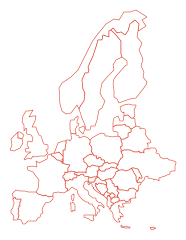
The gap looked like risk. It was really machinery.
The gap the funds were meant to close looked like a risk problem, and underneath it was something more fixable. Institutional investors do not avoid SMEs because they lack the money, or even the appetite; they avoid them because the machinery to reach them safely is usually not there. An institution cannot lend to a thousand tiny companies one at a time. It needs a fund to pool the risk, a legal structure that lets a non-bank actually originate loans, data good enough to underwrite at scale, and someone willing to take the first loss so the numbers work.
Europe had spent a decade assembling that machinery piece by piece: fund regimes that finally let non-banks lend, and development banks like the European Investment Fund (EIF) seeding the funds and guaranteeing the riskiest loans. Where the machinery existed, institutional money reached SMEs; where it did not, all the capital and all the need in the world could not bridge the gap. So the real question was never whether these funds worked. It was which of the parts that made them work a developing market could put in place.
How we pulled it together
Half the brief didn’t exist, and we said so.
The World Bank Group asked us to map two kinds of fund: those that lend to SMEs, and those that finance them by buying their receivables. We went looking for the second and found it was not there. The receivables side was run almost entirely by financial-technology platforms funding themselves through wholesale banks and securitisation, not by funds raising money from institutional investors at all. Rather than pad the report with a market that did not exist, we said so plainly and put the whole study behind the one that did, direct lending.
We mapped how the funds work, not just that they work.
A policymaker who wants to grow this market needs the machinery, not the headline. So we took a tangled market and reduced it to three business models a direct lending fund actually runs on: the fund that does everything itself, the fund that co-originates through a bank, and the fund that assembles the pieces from specialist partners. Each is a different way of splitting the work of lending, and naming them is what turned “encourage direct lending funds” into something a market could build toward.
We read the law, because the law is the market.
Whether a fund can lend at all is a question of local regulation, and for most of the last decade the answer across Europe was no, because originating a loan was treated as banking. So we mapped the lending law and fund structures market by market, across seven jurisdictions, showing exactly where a fund could originate a loan and under what structure. For a client asking whether the model could be copied, the regulatory plumbing was not background detail; it was the answer.
We wrote a playbook, including the part no one wants to hear.
The point of the study was not Europe; it was whether an emerging market could build the same channel. So we ended not with observations but with the pre-conditions and the specific steps a policymaker would have to take, and we did not soften the hardest one: this market does not start on private capital alone. Without a development bank willing to seed the funds and cover the losses when loans go bad, the risk is simply too high for institutional money to move, and any plan that pretends otherwise will fail.
What we delivered
This study lived or died on primary contact with the market. The two findings that mattered most, that the receivables-fund market did not really exist and that insurance companies, not pension funds, were the true buyers, could not have come from a database. They came from talking to the people running the funds. So the team was built to get into the room with fund managers and be taken seriously once there.
Thierry Clarke led the study and ran the analysis and the writing himself. What let the interviews go deep was that he came from inside the institutional investment world these managers work in, having spent years running institutional business across more than twenty emerging markets and dealing with the pension funds, insurers and asset managers who sit on both sides of these funds. A fund manager speaks differently to a peer than to a researcher, and it was that footing that surfaced what the published data had missed and let him tell the World Bank Group which of its two fund types was actually real.
The findings rested on more than twenty structured conversations with fund managers across Europe, six of them taken apart in full. Tsvetelina Zapryanova ran the coordination and the direct liaison with those managers, with analysts beneath her handling the gathering and the desk review of more than a hundred funds. The study was delivered in-house from end to end: the analysts did the legwork, the seniors ran the interviews and owned the judgment, and the whole thing turned on conversations no database could have replaced.
 Thierry Clarke
 Tsvetelina Zapryanova