A continent’s green ambitions, and no municipal bond market to fund them.
Grants and cheap loans had left a bond nowhere to sit.
 Location / capital-markets photography
EU Cohesion Policy exists to help its less-developed regions catch up, and it does that by funding the priorities the Union cares most about. The green transition is one of them. The difficulty is that the money is finite against the scale of what that transition needs. Most Cohesion Policy Funds are handed out as grants: spent once, and gone. Where the European Commission’s Directorate-General for Regional and Urban Policy (DG REGIO) has sought greater leverage, it has done so through Financial Instruments, and those have been largely loan-based. A loan multiplies public money only modestly.
DG REGIO wanted to know whether the capital markets could do better. Could Green and Sustainability-Linked municipal bonds make Cohesion Policy Funds go further, and draw private capital in behind them? Seven Member States were chosen as the test case, all candidate recipients whose municipal and sustainable bond markets were barely developed: Croatia, Czechia, Estonia, Latvia, Lithuania, Poland and Romania. On paper it read as a feasibility question. Answering it honestly meant getting to the bottom of each of the seven, one market at a time: the law that set what a municipality could issue, the state of its finances, and the readiness of the municipalities themselves. Most had never been near the capital markets: no green frameworks, no credit ratings, no one on staff who had done it before. On the other side sat the investors who would have to buy, willing in principle but not at a lower return for a green label.
- Solution & mechanism design
- Instrument structuring
- Framework development
- Regulatory & legal analysis
- Market & landscape analysis
- Financial modelling
- Recommendation & roadmap design
- Issuance structuring
- Investment risk analysis
- Benchmarking
- Interviewing
- Surveys & questionnaires
- Desk research
- Stakeholder validation
- Synthesis & report writing
- Knowledge-product & toolkit creation
- Training & capacity building
 Commissioned by
 Administered by
One brief. Seven markets.
1 Aggregated across the seven surveyed markets; the true need is materially larger.
2 Poland is around 90% of this, where most municipal “bonds” are in fact loans in bond form.

The support meant to build these markets was holding them back.
Feasibility was only the surface. The reason these markets had never formed lay a level beneath it, and it was not the law; most of the seven could already issue. It was that the way public money reached municipalities left no room for a bond. The largest share arrives as grants, which are spent once and leverage nothing. What is not granted is borrowed, and it is borrowed almost entirely through loans: DG REGIO’s Financial Instruments are largely loan-based; the European Investment Bank (EIB), a separate EU institution that works hand in glove with DG REGIO, provides long-term loans at very low rates; and the commercial banks, highly liquid and treating municipalities as near-sovereign risk, lend below the true cost of that risk. A bond cannot compete with money priced under the market. Between grants on one side and cheap loans on the other, it had neither the space nor the price at which to exist.
We had been asked whether these markets could support a green municipal bond. The deeper question was why they never had, when the public money meant to build them was being spent in the ways that made sure they wouldn’t.
How we pulled it together
We defined the brief before we answered it.
The brief was loosely defined; what sat behind it was not. DG REGIO wanted to put real capital to work through labelled municipal bonds, and you cannot deploy capital at scale into a market that barely functions. So we defined the task around that need: functioning markets, not a single issue to point at.
We built a way to measure what a functioning market needs.
There was no settled definition of what makes a municipal bond market work, so we wrote one: a diagnostic framework covering the capacity to issue, investors with the depth to buy, the structures to price and trade, and a funding gap real enough to matter. Built market-neutral.
Five models, built from real precedent.
Rather than copy one functioning market and hand it to all seven, we studied how sub-sovereign issuance had actually been done around the world and drew five models from that precedent, kept general and judged on their merits. One of the five was our own.
We modelled the instrument, to show what would have to change.
We built a working model of a Green Bond Financial Instrument, a demonstration of how EU Cohesion Policy Funds could support issuance. Modelling it in that detail surfaced what the programming rules would have to change, which we set out plainly for the next period.
What we delivered
The framework didn’t sit in a drawer. It was published for anyone to use.
The work became a public reference for labelled sub-sovereign issuance across the region: the clearest proof that the value outlasted the engagement.
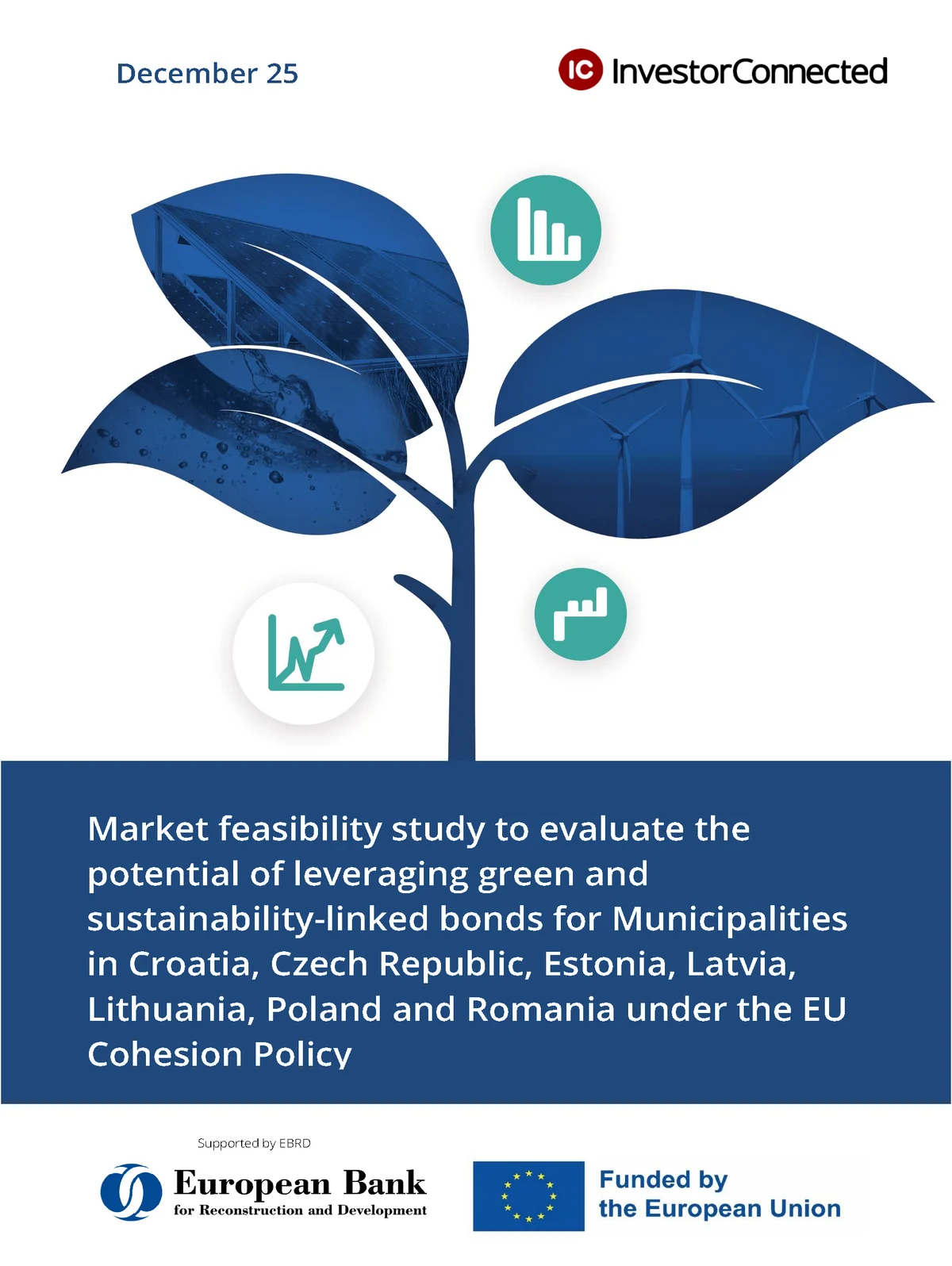 Published report cover
A green municipal bond market is not one problem but several meeting in one place: the instrument itself, the green label, the bank lending that competes with it, the EU rules that govern the money, and seven separate legal systems. Most firms would put capital-markets generalists across all of it. We did the opposite, and built the team as a map of the problem: a genuine specialist on each face of it, under one lead.
The two at the centre were a municipal bond specialist and a green finance specialist. Colleen Connors is one of very few people to have actually run municipal bond funds, so the instrument at the heart of this study was her own ground. Mike Brown has led over $3 billion of certified green municipal bond issuance, putting the green label in equally practised hands. Because the root cause was cheap lending crowding bonds out, the loan side had to be understood as sharply as the bond side, and Richard Jones brought that from a career spanning banking, capital markets and green finance. Reuben Fenech held the EU regulatory and policy angle, having helped build a nascent bond market from inside both the regulator and the institutions.
Thierry Clarke led as the capital-markets hand, across many prior EBRD and World Bank mandates; Tsvetelina Zapryanova, senior in her own right, coordinated a project running across seven countries at once. The legal work in each jurisdiction ran through Sorainen and CMS, two firms we partnered with, held under a single legal lead, so seven country positions came back in one shape, not seven. Small by design, and built so that every face of the problem was owned by someone who had done that exact thing before.
 Thierry Clarke
 Colleen Connors
 Mike Brown
 Richard Jones
 Reuben Fenech
 Tsvetelina Zapryanova